

On this page
What is "loop" in "loop marketing"?
The loop I mean is a loop over AI agents: Claude Code, Codex, OpenClaw, and similar tools.
The basic idea is simple. You call an agent repeatedly to complete a task that one agent run cannot handle well enough.
This already happens inside coding agents. When you ask a coding agent to build something, it usually runs its own smaller loop: plan, edit, run checks, inspect errors, fix, run checks again. That is why one serious agent task can easily cost real money. The agent is not just sending one prompt to a model. It is spending several rounds trying to get to a verifiable result.
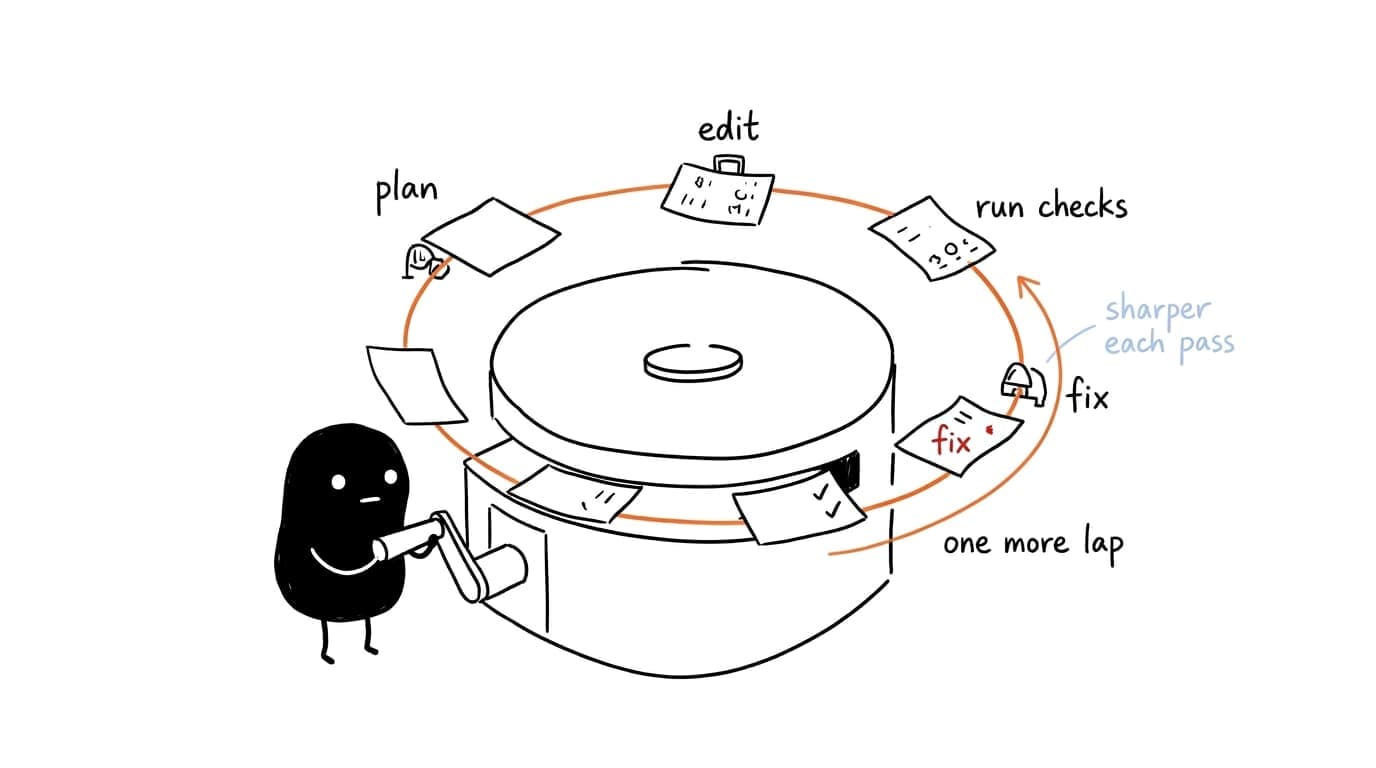
Coding has a nice property: many checks are concrete. The test passes or fails. The build passes or fails. The TypeScript compiler complains or it does not. If the check fails, the agent has a clear reason to improve the code.
Marketing is messier.
You cannot ask, "Will this campaign bring me 1,000 paying customers before I publish it?" and expect a truthful yes/no answer. No one can guarantee that. The goal is unrealistic, and you cannot fully verify market response before the market sees the work.
That does not mean looping is useless for marketing. It means the loop has to optimize for a different kind of progress.
For marketing, the loop should improve the draft against concrete questions: is the topic worth publishing, does the article hold together, are the facts real, can we prove what we say about the product, does it sound like us, and can people and search engines understand it? These checks cannot guarantee revenue before the work goes live, but they can remove quality issues that lower your probability of ROI.
What our loop looks like
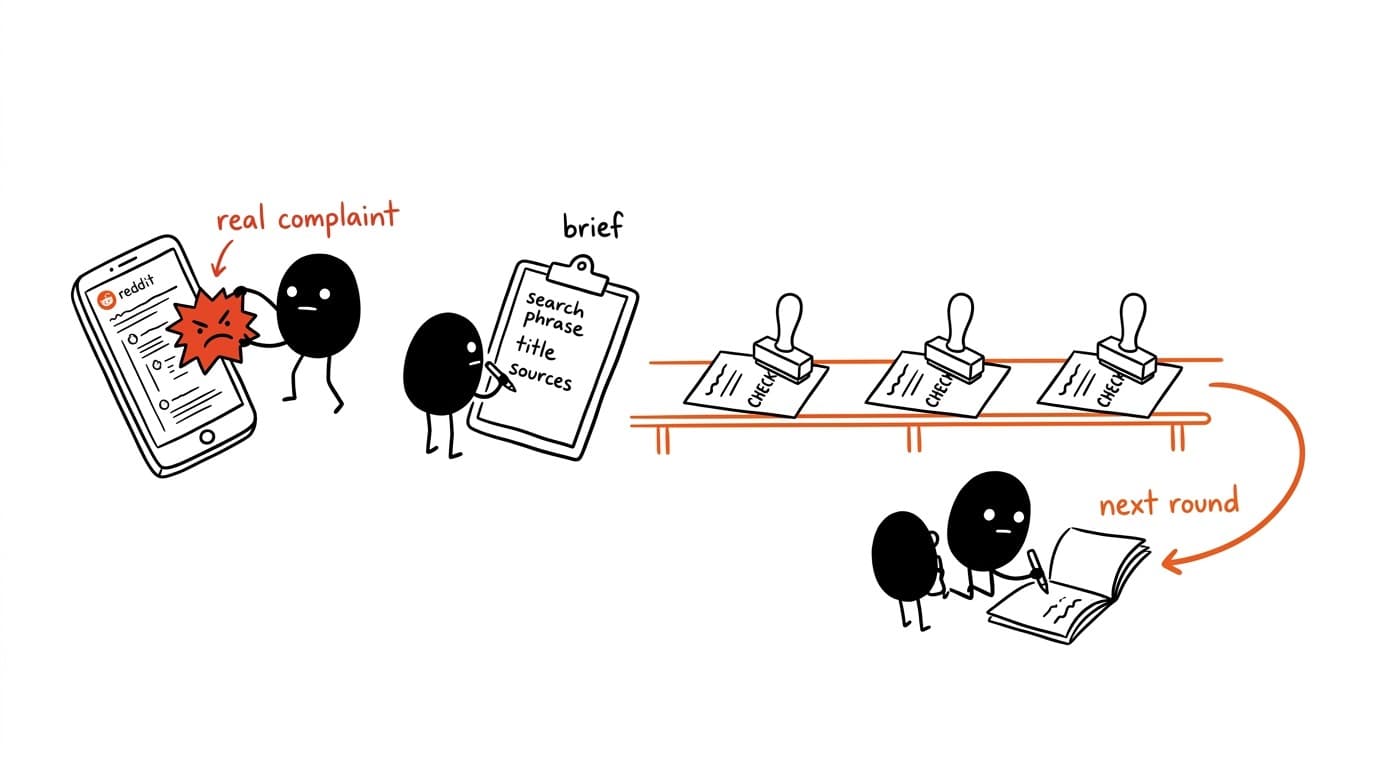
Our loop starts before the draft. dist0 reads Reddit for buyer pains, content ideas, and leads tied back to real posts. When a pain is worth turning into content, the Slack bot can turn it into a writer-ready content brief with a search phrase, title, ordered questions, and sources.
That brief is the starting point for the draft. The draft then goes through focused checks. We do not ask one reviewer to "make this better." Each check has one job.
| Check | What it catches |
|---|---|
| Topic worth | Generic topics with no original artifact |
| Coherence | Sections that do not support the title |
| Fact-check | Numbers, links, and claims without a real basis |
| Evidence-base | Product claims we cannot prove |
| Brand alignment | Product framing that does not sound like dist0 |
| SEO/GEO | Headings and answers search engines cannot extract |
| Writing style | AI tells, filler, and awkward wording |
The loop is simple: start with a real pain, draft from the source context, run the checks, fix what failed, and update the project context so the next run starts sharper.
Why we check drafts in separate passes
One broad review usually gives broad advice. Separate checks work better because each one has a narrow job: topic worth, coherence, facts, product proof, brand fit, search clarity, or writing style.
That is the part of loop marketing most people skip. They use AI to make more drafts, then judge the output with taste alone. We use AI to create the draft and to find the failure modes we already know to expect.
Why shouldn't you rely on interaction metrics to drive your loop marketing?
Marketing is a probability game. You can improve the odds of ROI, but you cannot deterministically guarantee it from a dashboard.
This is where a lot of "loop marketing" advice goes wrong. People want the loop to be driven by interaction metrics: upvotes, comments, reposts, likes, saves, click-through rates. Those numbers are not useless, but they are dangerous if you let them decide the whole strategy.
They describe what happened last time. They do not automatically tell you what your market will care about next.
Worse, they can reward the wrong behavior. High interaction ≠ business value.
Take an extreme example. Posting NSFW content on Reddit can generate visibility. That does not mean it helps a SaaS business win real users. A smaller post in the right niche, answering a real problem with care, may produce fewer visible interactions and still create more qualified conversations.
Even when interaction metrics point toward a useful direction, that does not mean you can mass-produce the same thing forever. Most channels punish spam, keyword stuffing, and obvious AI slop. What they reward is usually a proven format filled with genuinely useful substance.
For SaaS, the priority is not to find the most viral post type. The priority is to find a content framework you can repeat without becoming generic.
A viral post has a ceiling. A scalable framework compounds.

How do we find a scalable content framework that can be looped?
Start with your brand identity and your actual market, then let AI propose proven formats that fit.
You do not need to invent a new marketing framework from scratch. Most useful formats are already known. The hard part is matching the right format to your product, your audience, and your available proof.
For SaaS, several formats tend to work well:
- First-hand comparison pages. A set of genuine
/vspages can capture bottom-of-funnel demand when they come from real product experience, not fake neutral summaries. - Integration and workflow content. Integrations take effort, but they create repeatable content. You can build small demos with Claude Code or Codex, then publish "how to use A and B to do X" guides. On X, the same idea can become a short contrast: "Bad workflow: manual. Better workflow: A -> B."
- Community-sourced pain content. Let AI read real discussions on Reddit or other communities, find questions and complaints you can help with, and draft useful replies. Then do not stop at the reply. Turn the same source material into SEO posts, X posts, Reddit stories, and short videos.
That last one is especially useful because the raw discussion already contains detailed context: the problem, the failed workaround, the tools people tried, the constraints, and the language buyers use. You are not asking AI to fill a blank page with generic advice. You are giving it the details it needs to stay grounded.
The key is not just that Reddit gives you a topic. It gives you detailed context. A short reply can answer with the solution you would personally recommend. A full SEO blog built from the same thread should cover the broader solution space: alternatives, tradeoffs, when each option fits, and where your product belongs.
The common trap is starting from keyword databases alone.
Tools like Ahrefs or DataForSEO are useful, but they usually do not give enough concrete context for a strong article. If you only start from a keyword, the agent tends to replicate what already ranks and hope your version is better. That is a weak strategy for a new site with low domain authority.
A better foundation is buyer pain. Use dist0 to capture real problems from the Reddit communities it watches for you. Do not guess. Do not copy the current search results and call it strategy.
The loop becomes much stronger when the input is a real pain, not just a keyword.

How to run the loop yourself
You do not need our exact setup to copy the shape.
- Pick one repeatable content format.
- Feed it a real buyer pain or content idea.
- Draft from the source context, not from the keyword alone.
- Run focused checks for topic worth, coherence, facts, proof, brand fit, search clarity, and writing style.
- Fix what the checks catch.
- Update your notes and filtering rules so the next run starts with better context.
The order matters: repeatable format first, review loop second. Without the format, you are just reviewing random assets. Without the checks, you are just producing more content.
The point of the loop
The point is not to publish more assets.
The point is to find a content format that can repeat, then make each run sharper. The inputs get better because your system learns which pains fit. The drafts get better because they start from real context. The claims get safer because you keep track of what you can actually prove.
That is the compounding part. Not volume. Better context, better checks, and fewer guesses each time you run the loop.
Frequently asked questions
What is loop marketing for SaaS?
Loop marketing is a repeatable system for creating and improving marketing assets. For SaaS, we use it to find buyer pain, draft useful assets, run focused checks, fix gaps, and reuse the learning in the next round.
Can AI agents fully automate SaaS marketing?
No. AI agents can handle research, drafting, repurposing, and quality checks, but human judgment is still needed for product truth, customer context, positioning, and taste. The loop works best when agents do the repeatable work and humans supply the original insight.
What should a marketing verifier check?
A good verifier checks one kind of issue at a time. In our workflow, that means checking topic worth, coherence, facts, product proof, brand fit, search clarity, and writing style.
Why not use engagement metrics as the main loop signal?
Engagement metrics describe past reactions. They can help you notice patterns, but they do not prove business value. A SaaS loop should care more about buyer pain, content quality, and repeatable frameworks than raw likes, upvotes, or reposts.