
Loop Content Marketing: Loop for Quality, Not Clicks
We borrow the loop from AI coding agents — draft, run checks, fix, repeat — and point it at content quality. But no automated check can tell whether a page has information gain. That part is still on you.
 Tao WuFounder of dist0
On this page
- What "loop" means here
- Loop marketing vs loop engineering vs loop content marketing
- What our loop checks
- Where the draft starts (how dist0 sources it)
- Why separate passes beat one big review
- We loop for quality, not clicks
- Where we part ways with HubSpot's loop marketing
- What the verifiers can't check: information gain
- A source anyone can replicate: buyer pain
- A good loop improves itself
- How to run the loop yourself
- The point of the loop
What "loop" means here
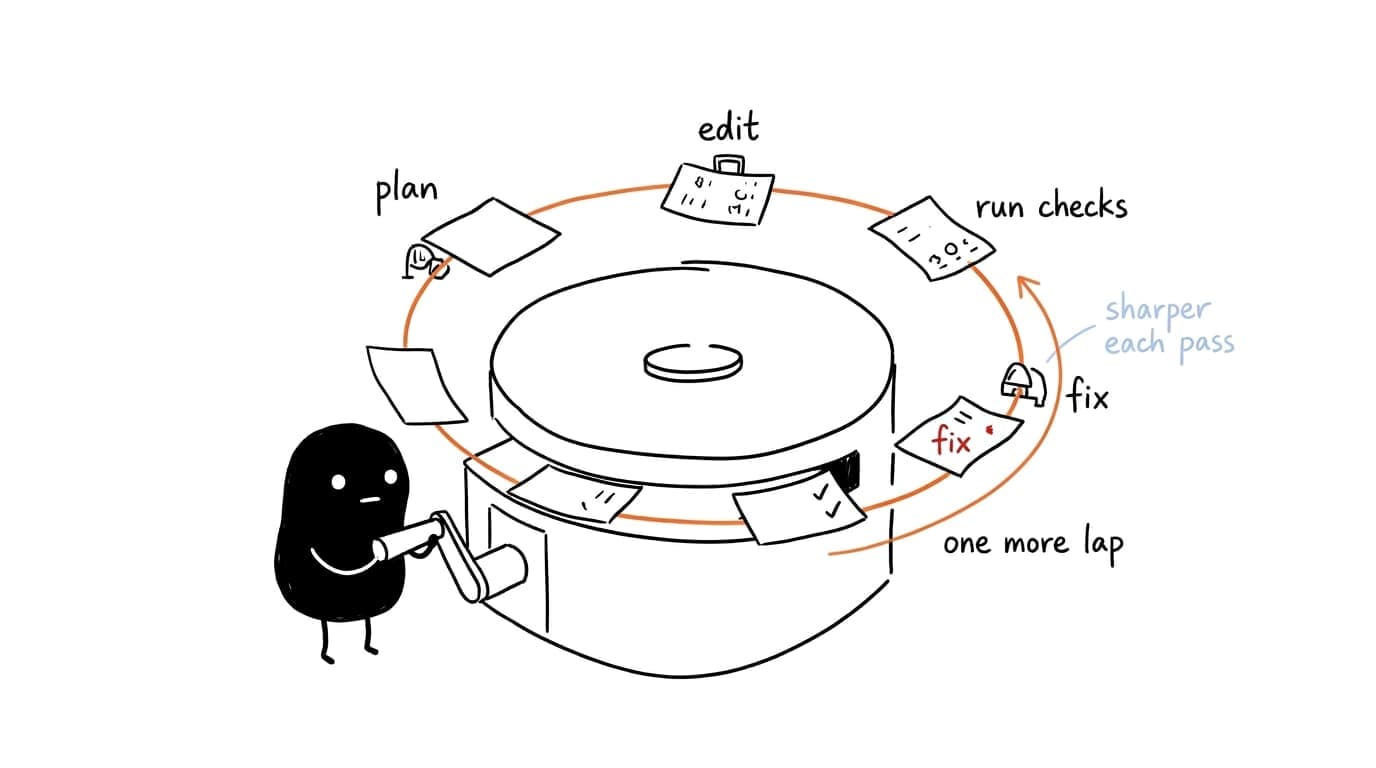
The loop is repeated calls to an AI agent — Claude Code, Codex, and similar tools. You call an agent repeatedly on a task one run cannot finish well — it plans, edits, runs a check, reads the error, fixes, and checks again.
Loop marketing vs loop engineering vs loop content marketing
In engineering, this loop is nothing new. Coding agents run it every time you ask them to build something, because the checks are concrete: the test passes or fails, the build compiles or it doesn't. A failed check is a clear reason to try again. Call that loop engineering — looping against pass/fail signals until the code is correct.
"Loop marketing," the way HubSpot popularized the term, is something else: a broad playbook for the whole AI-era funnel. Its core idea is to stop treating marketing as a straight line that ends at the sale, and instead run it as a cycle — every action teaches you something you feed into the next one, so the whole growth engine keeps improving over time. It spans everything you do to grow, not just content.
We don't mean that. What we run sits between the two, and it's more honest to call it loop content marketing — just like loop engineering, but aimed at content, where the checks are fuzzier and the signal that matters most — whether the page has information gain — can't be automated at all.
Because marketing is messier. You can't ask "will this post bring 1,000 customers?" and get a truthful yes or no before you publish — no check tells you how the market will react. So the loop can't optimize for engagement metrics directly — you don't have them yet. It optimizes for something you can judge before publishing: whether the draft is good enough to deserve a chance.
What our loop checks
For content, the loop improves a draft against concrete questions, each handled by its own verifier:
| Check | What it catches |
|---|---|
| Topic worth | Generic topics with no original research behind them |
| Coherence | Sections that don't support the title, or dishonest groupings |
| Fact-check | Numbers, links, and claims with no real basis |
| Product proof | dist0 claims we can't trace to first-hand evidence |
| Brand alignment | Framing that doesn't sound like dist0, or names competitors |
| SEO/GEO | Headings and answers search engines can't extract, unearned links |
| Writing style | AI tells, filler, and awkward wording |
If you know a little programming, here is how we run the loop:
while true; do
  output=$(claude -p "/verify-blog <blogpath>")   # one round: check, then fix
  echo "$output" | grep -q "no issues left" && break
doneEach pass dispatches one focused verifier per check, collects what failed, applies the fixes, and runs again. We do not ask one reviewer to "make this better." Each check has one job, and the loop repeats until every check passes.
Where the draft starts (how dist0 sources it)
The verifiers gate the draft, but the draft needs a starting point, and that comes before the loop. The general rule is simple: start from original, first-hand material, not a keyword. How you source that material is your choice; here is how dist0 does it.
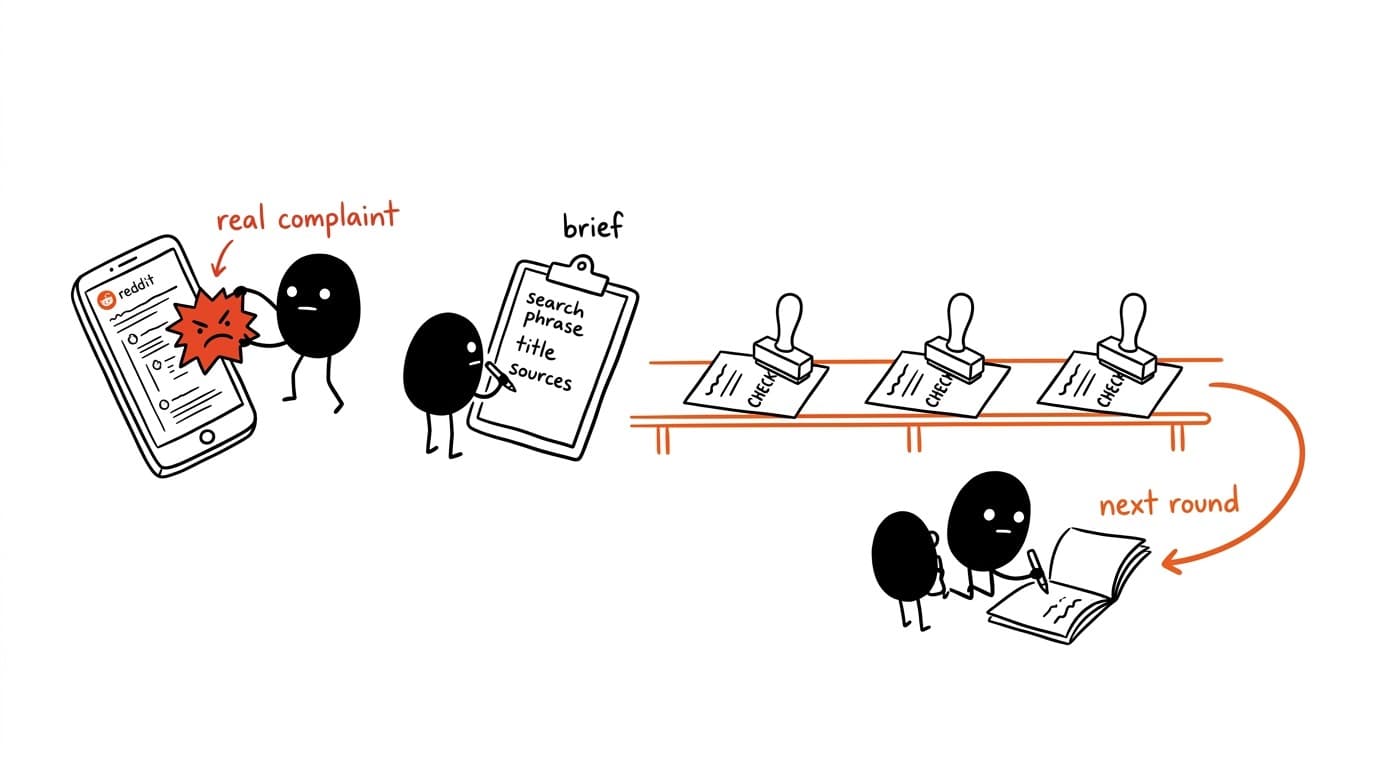
dist0 reads the Reddit communities it watches and surfaces what buyers struggle with, traced back to the posts it came from. The signal we focus on here is recurring pain. When one pain recurs 20 or more times across distinct authors, we treat it as a topic worth writing — a pain-point pattern we can deep-dive — and create a draft for it.
Why separate passes beat one big review
One broad review gives broad advice. Separate checks work because each has a narrow job — topic worth, coherence, facts, product proof, brand fit, search clarity, or writing style. That's the part most people skip: they use AI to churn out more drafts, then judge them by gut feel alone, with no systematic checks. We use AI to write the draft and to hunt the failure modes we already know to look for.
The verifiers are the success criteria. Pass them and we treat the draft as publishable — not guaranteed to rank, but free of the quality faults that lower the odds.
We loop for quality, not clicks
Here is where most "loop marketing" advice goes wrong: it wants the loop driven by interaction metrics — upvotes, comments, likes, click-through. Those numbers are not useless, but they are dangerous when you let them steer the loop.
They describe what performed in the past, not what will land in the future. Worse, they reward the wrong behavior: high interaction ≠ business value. Posting NSFW content on Reddit earns visibility and wins no SaaS users. A smaller post that answers a real problem in the right niche can show fewer interactions yet reach more of the people who might actually become customers.
And you cannot mass-produce a winner forever. Most channels punish spam and obvious AI slop; what they reward is a proven framework filled with real substance. A viral post has a ceiling. A repeatable framework compounds.

Where we part ways with HubSpot's loop marketing
HubSpot's loop closes each round on engagement and conversion numbers: publish, watch how people react, and let those signals pick the next move. We think that leans on the numbers too much. They give you past data, not what will rank in the future — they can't hold a standard for what is worth publishing.
Our loop closes on quality instead. The verifiers are AI agents, and they loop on their own until no issue is left to find. Then a human steps in for the final publish review. If anything still falls short, we write down that feedback — and only that human feedback folds back into the verifiers, sharpening the checks for next time. It is a smaller loop with a human at the end of it, on purpose. We don't buy that a loop can run itself on metrics alone: someone still owns the taste and the criteria, and we would rather that stay a person.
What the verifiers can't check: information gain
Passing the verifiers gets you a quality floor, not a ceiling. The one thing no verifier can score is the thing that actually decides whether content is worth publishing: information gain — whether the page adds something the rest of the web, and the models that have read it, do not already have.
You cannot automate that check, so you have to supply it on purpose. It comes from original research and first-hand experience — rough is fine, as long as it is real. A model that read the same Reddit posts can regenerate a tidy summary; it cannot regenerate what you actually observed.
The trap is starting from a keyword database alone. Ahrefs or DataForSEO tell you what is searched, never the human context behind it. Start from a keyword and the agent tends to replicate what already ranks — a weak move for a new site.

A source anyone can replicate: buyer pain
One raw material that works well is buyer pain — for example, the Reddit posts dist0 surfaces, which already carry the problem, the failed workarounds, the tools people tried, and the exact words buyers use. That is real information gain you can gather without having to live through it yourself. It's just one source; anyone can replicate the approach and build their own with dist0.
One framework that turns that material into a repeatable asset is the pattern report: "N patterns behind [a specific pain], and M fixes people tried, from K Reddit posts." It's one kind of content framework that's hard to copy — you own the angle of reading those posts and naming the buyer pain in them, which is exactly what someone searching that pain wants to read. We wrote that framework up separately in how we scale original research for content marketing.
One tip that matters: don't publish a pattern report as a one-time post. Treat it as a living analysis you update as new pains recur. A page you keep updating as a real question recurs keeps pulling search traffic in a way a dated one-off never will.
A good loop improves itself
The point of a loop is not one clean pass. It is that each run starts sharper than the last. Two things get better over time:
- The verifiers, when a human sharpens them. The checks don't change on their own each run. At the final publish review, a person reads the draft against our quality bar and, when a check should have caught something and didn't, we fold that lesson into the verifier — so future drafts meet a tighter bar.
- The signals, on their own. As more posts recur, dist0 merges related pains, so the pattern you report widens from a handful of threads into a documented, recurring one.
That is what makes the framework compound, and why it matters more than any single asset.
How to run the loop yourself
You do not need our setup to copy the shape:
- Pick one repeatable content framework — one that gets better each time you run it.
- Feed it real, first-hand material — original research, data, or lived experience — not a keyword.
- Draft from that source, not the search term.
- Run focused checks — topic worth, coherence, facts, proof, brand fit, search clarity, writing style.
- Fix what they catch.
- When a human reviews the final draft, fold their feedback into the checks — and let recurring signals regroup into broader patterns over time.
Framework first, checks second.
The point of the loop
The point is not to publish more. It is to find a content framework that repeats and compounds, then make each run sharper — better inputs because the system learns which pains fit, better drafts because they start from real context, safer claims because you track what you can prove.
That is the compounding part. Not volume — better context, better checks, and fewer guesses each time you loop.
Frequently asked questions
What is loop content marketing?
Loop content marketing borrows the loop from AI coding agents — draft, run checks, fix, repeat — and points it at content quality. We loop to get a draft past a set of focused verifiers, starting from real buyer pain on Reddit, instead of looping to chase engagement numbers.
How is loop content marketing different from loop engineering?
Loop engineering checks code against pass/fail tests, so a machine can tell when it is done. Content has no such test for the thing that matters most — information gain — so the loop uses verifiers to enforce a quality floor and relies on original research, like Reddit buyer pain, to supply the gain a verifier cannot score.
Can AI agents fully automate SaaS content?
No. Agents can handle research, drafting, repurposing, and quality checks, but information gain — original research, first-hand experience, product truth — still comes from you. The loop works best when agents do the repeatable work and humans supply the original insight.
What should a content verifier check?
One kind of issue at a time: topic worth, coherence, facts, product proof, brand fit, search clarity, and writing style. Passing them all means the draft is publishable, not that it is guaranteed to rank.