
I Made Claude Code My Project Manager (and Open-Sourced It)
How I turned Claude Code into the project manager for a team of one: a kanban skill that turns a one-line goal into a self-filling board, learns from what I reject, and leaves every ship decision to me.
 Tao WuFounder of dist0
On this page
- What "Claude Code as a project manager" actually means
- The problem it solves: project management for a team of one
- Inside the kanban skill: one goal in, a board out
- A board that fills itself — and learns
- The rule that keeps it honest: I decide what ships
- How to set up your own
- What I'd tell another solo founder
I'm a solo founder. I run dist0, and for most of a year I had zero project management — keeping any kind of task board updated was work I never had time for, so I just held what I could in my head. Then I stopped using Claude Code one task at a time and handed it the whole board instead: every task I'm tracking, in one place it keeps up to date. This is how the setup works, and why I pulled it out into a kanban skill anyone can install — a simple board that moves tasks from idea to done.
What "Claude Code as a project manager" actually means
Most people use Claude Code one task at a time: hand it a job, it does the job, you move on to the next one. Using it as a project manager is the opposite. You let it hold and move the whole board on its own, and you show up to decide.
That means the work you'd normally do by hand gets handed off:
- A feature idea → it sketches how the feature should look and work.
- A piece of content → it does the keyword research and lines up the topics for you to review.
- A vague goal → it breaks that into the actual tasks, laid out on a board.
The input is still mine. Every real decision is still mine. What changes is the middle — the breakdown, the first draft of the plan, the busywork between "I want this" and "here's what that means." That's the part I stopped doing myself.
The problem it solves: project management for a team of one
When you're solo, you own project management on top of building, selling, and support. It's also the easiest job to drop: no teammate is waiting on the board, so keeping it updated feels like busywork you can skip.
I used to track everything in GitHub Issues, by hand — writing them, labeling them, closing them, keeping the board honest. Keeping it all current by hand ate hours I'd rather spend building the product, so I stopped. I didn't switch to a better tool — I switched to nothing. Most days I opened one Claude Code session and worked from whatever I still remembered needed doing.
It works until it doesn't. You lose the thread between sessions. Good ideas evaporate overnight. Anything that isn't on fire never gets done, because nothing is holding it for you. Solo founder project management fails in a specific way — not because the tools are bad, but because you're the only one holding it all in your head, and you can't.
Inside the kanban skill: one goal in, a board out
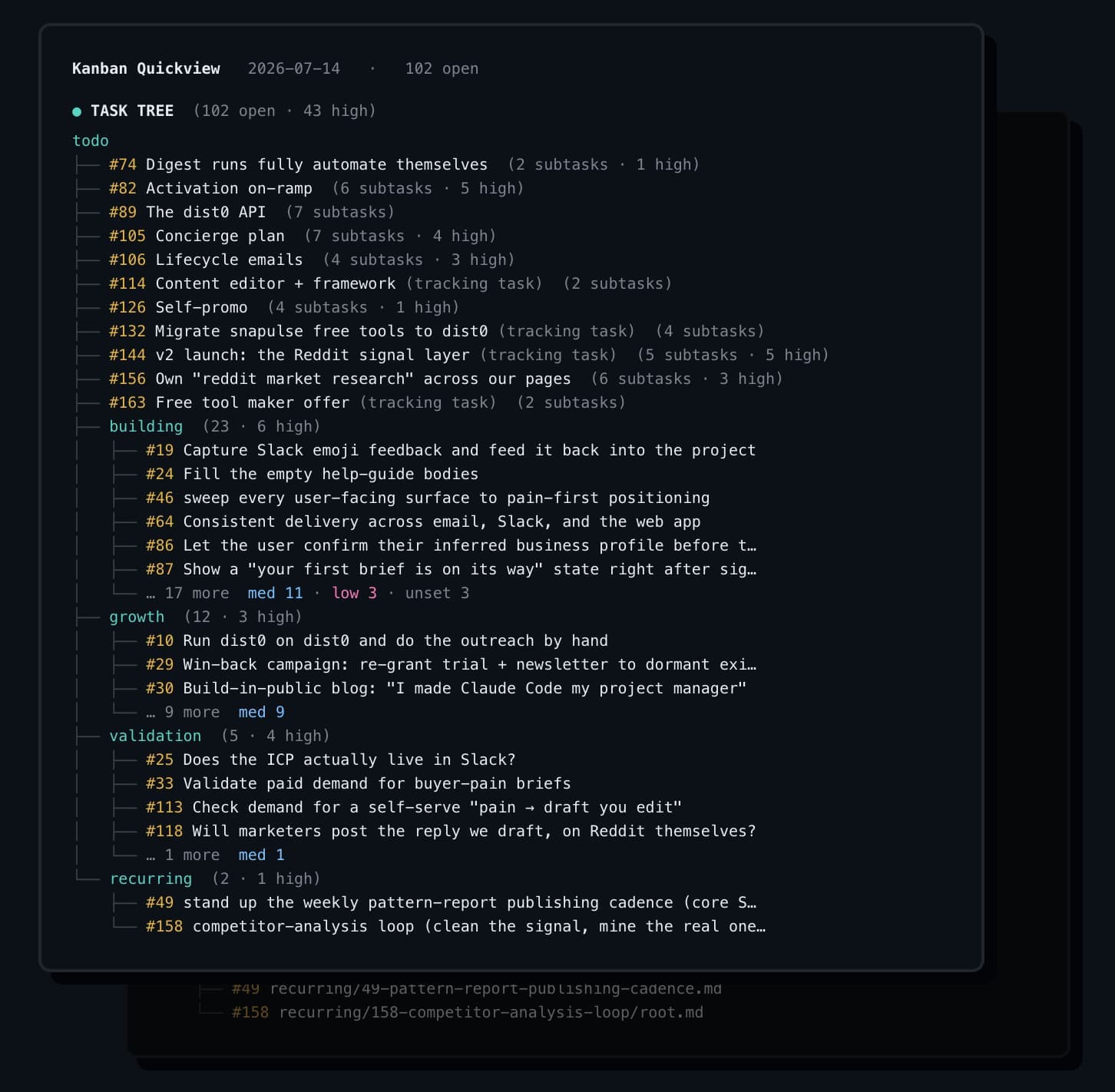
So I wrote a small kanban skill to hold everything I couldn't keep in my head. It's a Claude project management skill in the plainest sense: I don't write tidy tickets for it. I give it a rough goal, one line, and it turns that into a task, or a whole set of them.
Say my goal is "rank for a pillar phrase." I don't break that down myself. The skill hands me back candidate pieces to write — a best-of listicle, a comparison page, a landing page — including angles I wouldn't have reached on my own. I go from a vague intention to a board I can actually pick from.
That's what makes it an AI kanban skill and not just a to-do list: the goal is the input, the board is the output, and the tedious step between them is gone.
A board that fills itself — and learns
A board you still have to fill and tidy by hand is just a to-do list — the AI hasn't saved you anything yet. Two things change that and let the board keep itself current.
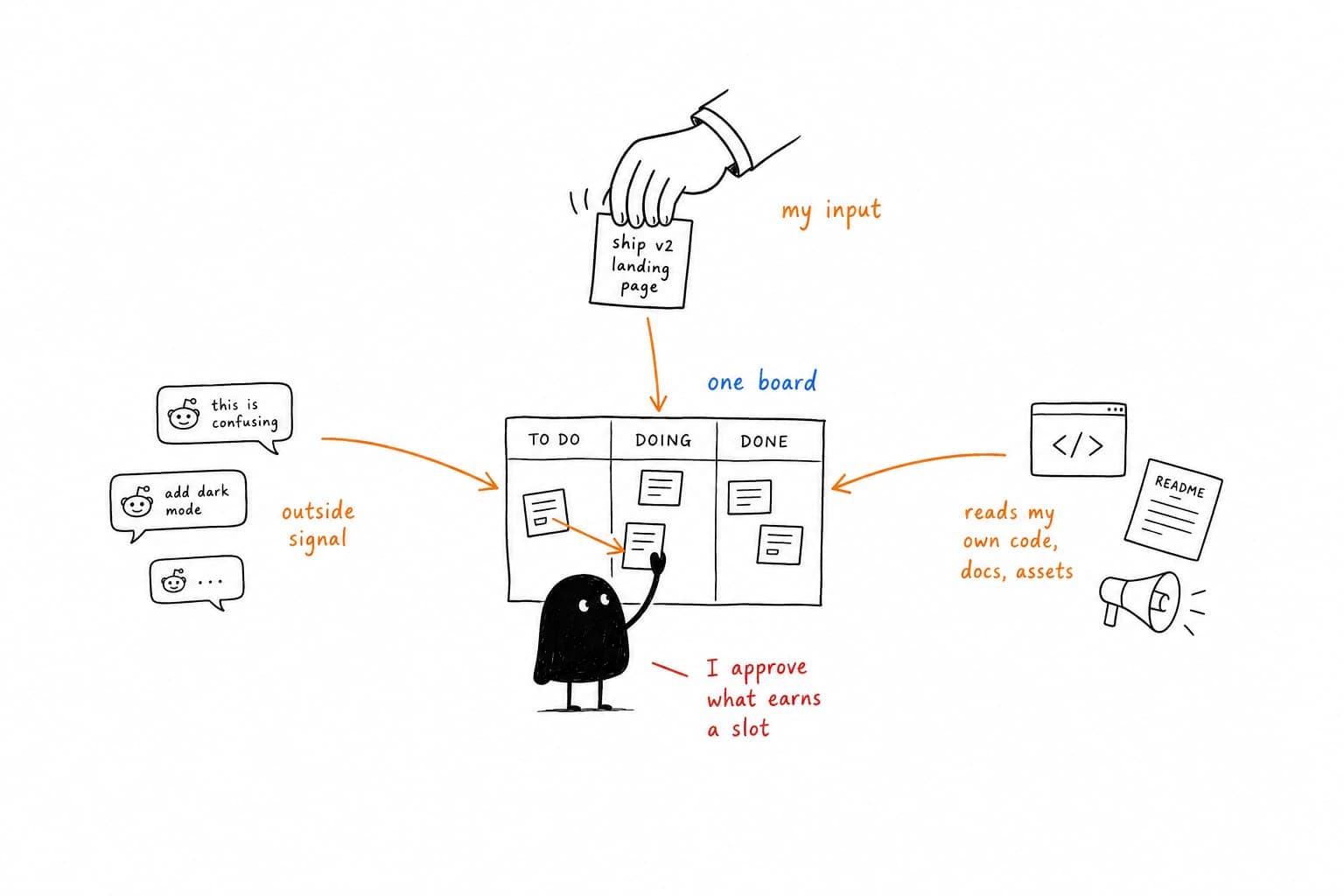
It fills from three places, not just my own head.
- The goals I hand it — a one-line intention, typed straight in.
- Buyer pains and competitor mentions from Reddit — dist0 (the product this whole setup is built for) reads Reddit and surfaces what buyers are struggling with and where competitors come up. The board turns those into feature ideas and tasks.
- My own codebase — the skill reads the code, docs, and marketing pages I keep in the repo and flags the half-built features and gaps I'd forgotten.
Three sources, one board — but nothing lands on it until I approve it. Those Reddit buyer pains aren't only for the board, either; I feed the same material into my content, which I wrote about in loop content marketing for SaaS.
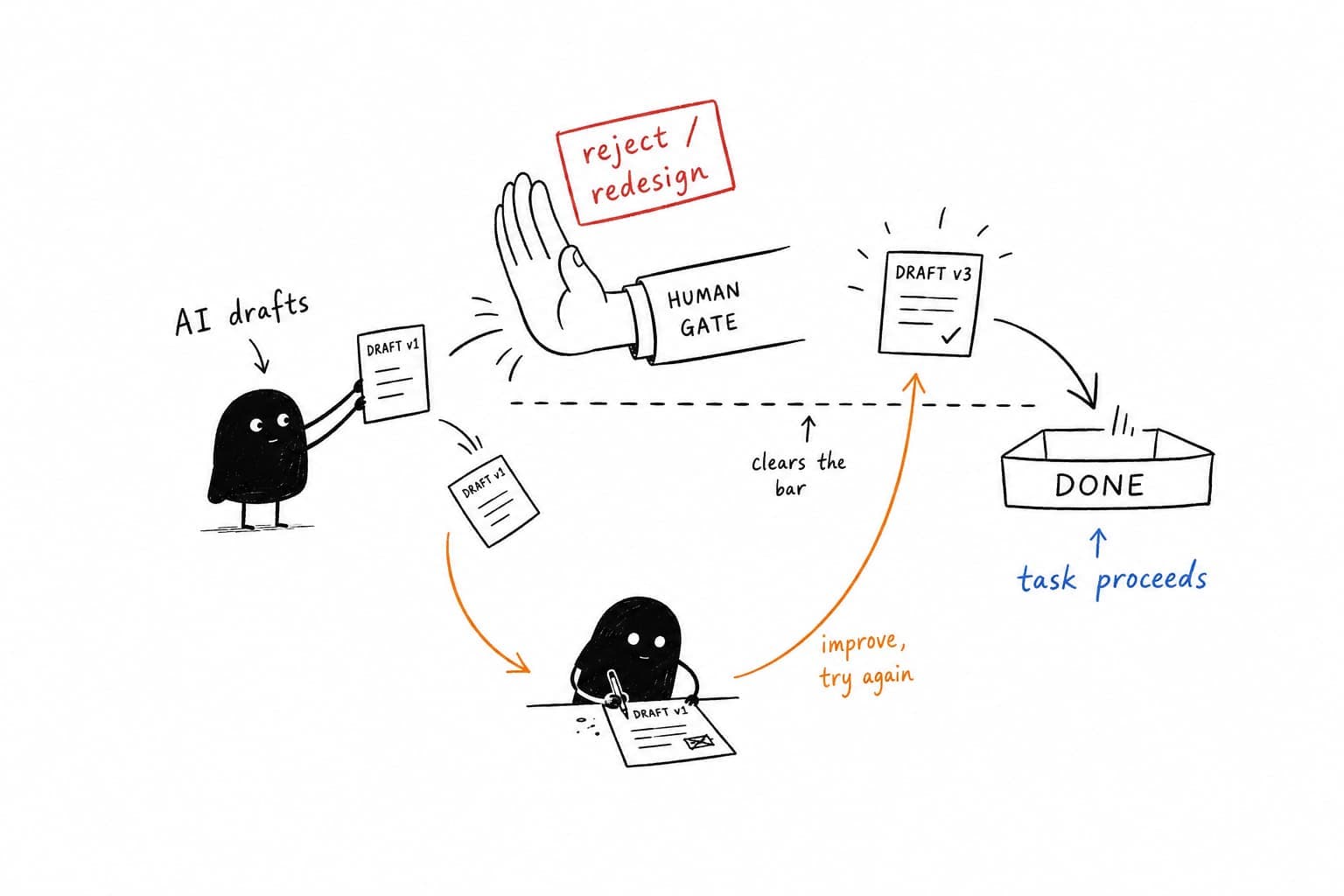
It learns from what I reject. When I turn down a task, or tell it to redesign one, it writes down what I rejected and why — into a memory it reads before the next round. So it stops pitching me the same thing I already said no to. The memory prunes itself, so it doesn't bloat into noise over time. That's the difference between a tool that remembers and one you have to re-explain yourself to every morning.
The rule that keeps it honest: I decide what ships
Here's the line I won't move: the AI can fill the board, but it doesn't get to choose the roadmap.
To keep myself in that seat without drowning, I have the skill run one task every day: it pushes each high-priority card one concrete step forward, and it writes up the open questions it couldn't settle on its own — the calls that need me. I read that short list of open questions every day and answer them. That's the whole check-in.
It's still not autonomous enough. The next thing I'm chasing is closer to a small team than a single assistant — agents that go do their own research, or a couple of them that argue an idea out before it reaches me. Less "here's a task," more "here's a decision, already pressure-tested."
How to set up your own
You don't need my exact setup — the idea travels. But if you want a head start, the kanban skill is on GitHub, with a quick overview of the kanban skill. Drop it into your own Claude Code workflow, point it at a goal, and let the board manage itself from there.
Frequently asked questions
Can Claude Code work as a project manager?
Yes — not as a task tracker you fill by hand, but as something that holds and moves the board for you. You give it a one-line goal, it breaks that into tasks, and it keeps them current across sessions. The catch is that it should propose and draft, not decide: you still own what actually ships.
What is the kanban skill?
It's a small, open-source Claude Code skill that turns a rough goal into a board of tasks and keeps that board moving. It learns from the tasks you reject, prunes its own memory so it stays clean, and can pull in outside signals — for me, Reddit buyer pains from dist0 — as new work.
Do I still need Jira, Linear, or GitHub Issues?
For a team, probably. This is built for a team of one, where the overhead of maintaining a formal tracker is the reason the tracker gets abandoned. The kanban skill removes the maintenance — you talk to it in plain language and it keeps the board — so solo founder project management stops depending on your discipline.
Is the kanban skill free?
Yes, it's open source. You can read it, run it, and change it. The Reddit buyer pains and competitor mentions I plug into it come from dist0, which is a separate product, but the board itself is free.
What I'd tell another solo founder
If you're running solo, the trap isn't that you lack tools. It's that you become the tool. Every breakdown, every plan, every "what's next" routes through your one head — and that caps how much you can carry.
The fix that worked for me wasn't more discipline. It was moving one line and defending it: I keep the decisions — what matters, what ships, what's good enough — and hand everything on the other side to Claude Code. The board fills itself. The plans draft themselves. I show up to approve, correct, and decide.
You don't have to copy my exact setup. But get out of the job of writing, filing, and chasing your own tasks — stop being your own ticket clerk.