
How to Find Customers on Reddit: What 580 Threads Reveal
Most advice says go where people already complain about your problem. Most guides skip the two skills it actually takes.
 Tao WuFounder of dist0
On this page
- How do you actually find customers on Reddit?
- Are you the only one who can't find them?
- Why does finding customers on Reddit feel like an endless manual grind?
- What Reddit outreach actually worked — and what flopped?
- How do you tell a real buyer from someone just curious?
- What does a repeatable way to find customers on Reddit look like?
- The pattern, in one line
If you've searched how to find customers on Reddit, you've already met the advice. It's everywhere, and it isn't wrong. The trouble is that it stops right where the hard part begins. So here's what founders actually say when they try to do it.
How do you actually find customers on Reddit?
The short version that kept showing up in those founder comments: go to the places where people already complain about the problem you solve, and show up there like a person, not a billboard. That's the useful advice. Everything that makes it hard comes later.
The first thing the threads quietly correct: it's not "post more." It's the reverse — stop broadcasting and go find the conversation that's already happening. u/Avengerfx, starting from basically zero himself, said it plainly:
"post consistently" is too vague to be useful. What seems to matter more is finding places where the problem is already being talked about.
u/farhadnawab compressed the whole turn into two sentences:
your first customers almost never come from content. they come from conversations. go find where your target people already hang out and just talk to them.
And u/EvosJourny explained why posting harder doesn't work — you're usually shouting in the wrong room:
customers don't congregate in product communities. They hang out discussing the actual problem.
So the move isn't volume, it's location. Don't post into your own empty account and hope; go to the thread where someone is already describing the pain you fix, and join it. That's where the strongest advice points.
Are you the only one who can't find them?
Not even close. The reason founders go looking on Reddit at all is a recurring gap that several described plainly. Here's u/aasimpthn in r/SaaS:
There seems to be a huge gap between "build the product" and "people actually find it."
The original poster of a thread on reaching customers with no following put the starting-from-zero version of it:
It feels like every marketing advice starts with "post consistently on social media," but starting from zero is difficult.
And u/Vegetable-Ice7332, six months into building SaaS products in r/startups, named a ceiling many founders described:
I can usually get the first few users through my network, direct outreach, or by posting in a few relevant communities. But after that, growth quickly slows down. It feels like I keep hitting the same invisible ceiling.
Across 580 posts I read, 63 raised a real pain of any kind. 14 of them — more than 1/5 — were some version of this: I know I'm supposed to find where my buyers are, but I can't actually find them. It showed up often enough to become its own pattern.
Why does finding customers on Reddit feel like an endless manual grind?
Many guides understate this: "go where they complain" is a sentence. Doing it is a job. The founders who actually try it describe the same slow, noisy slog.
Avengerfx, again, on what "finding the conversation" really means day to day:
For me, that means searching Reddit, LinkedIn, X, niche communities, old forum threads ... It's slower than ads and way less clean than a funnel.
u/IHaveARedditName did it by hand long enough that he gave up and wrote code instead:
I spent a lot of time early on watching subreddits and ended up building a feed listener that just pings me when it finds something, instead of me having to check all the time.
u/systemsbuilderx was asked what eats the most time in his entire business. He answered directly:
Finding actual high intent users for my tool.
And the grind isn't just hours — it's the feeling of guessing. u/property-flow-hq built property software and still couldn't locate his buyers:
I can't seem to find where small landlords who own 1 to 20 units that still don't use software [hang out] ... So how would you look? And where?
u/Motor-Credit8336 summed up the whole feeling:
It's a spray and pray kind of method as far as I can tell.
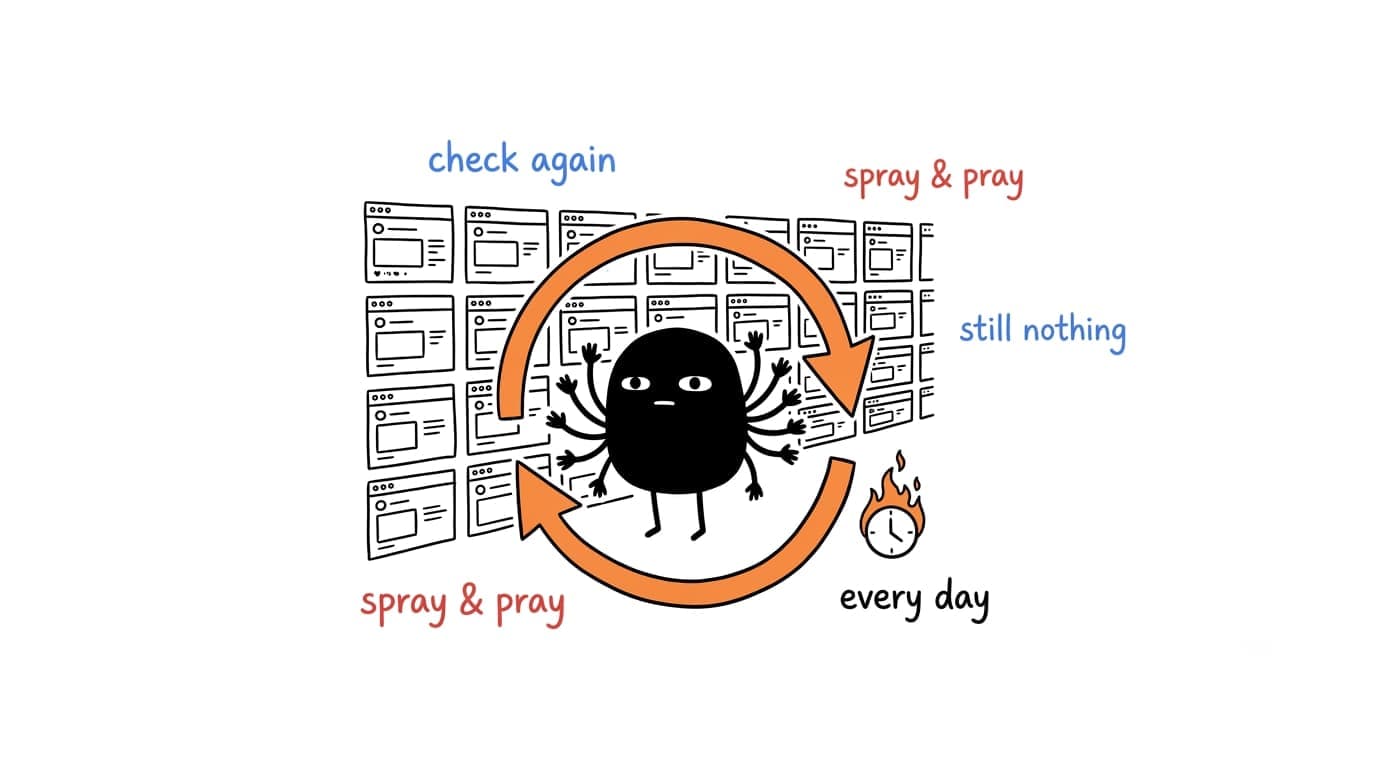
That's the part the advice skips. "Go to the threads" means refreshing subreddit after subreddit, reading past a wall of noise, and still ending the day unsure whether any of it mattered.
What Reddit outreach actually worked — and what flopped?
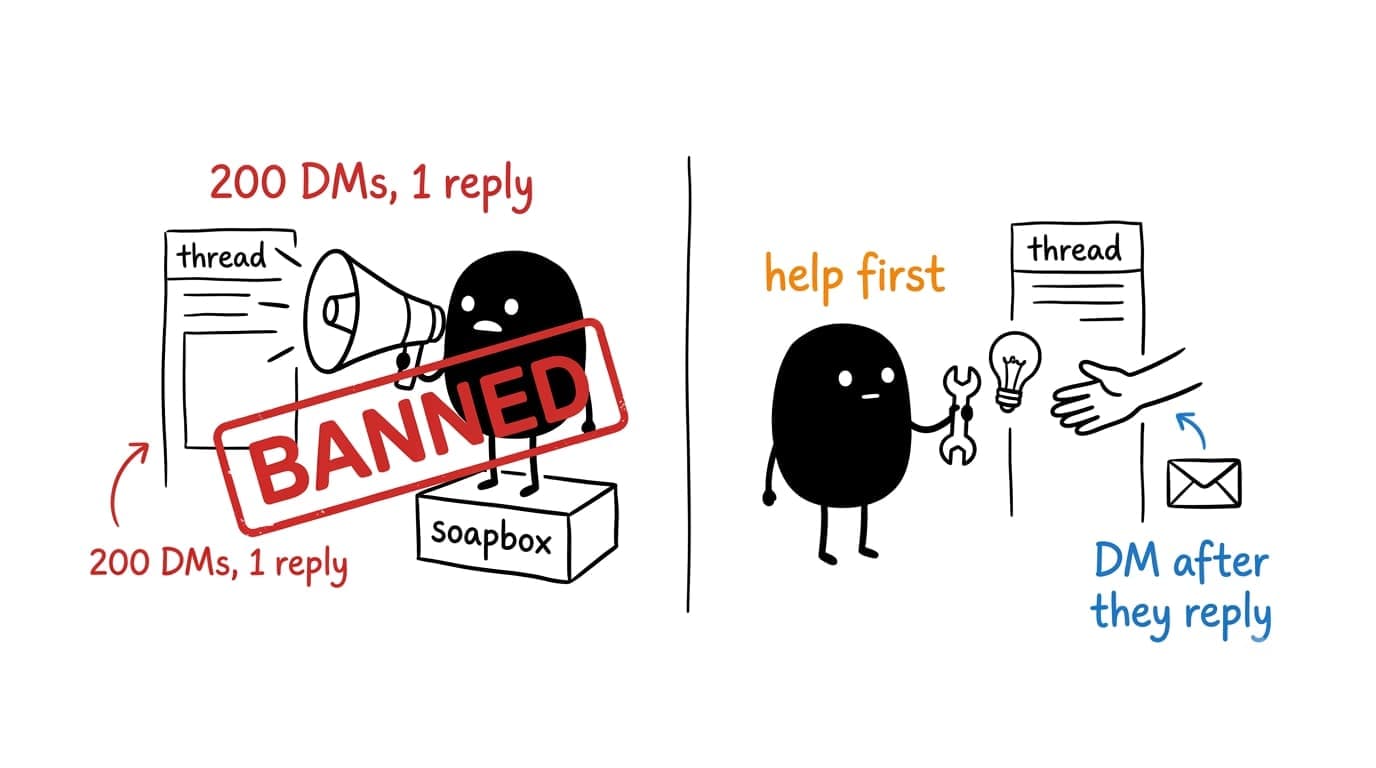
Complaint-tracking plus helpful comments turned into calls; cold email and cold Reddit pitch DMs flopped. The useful sequence was: track complaints, say something genuinely useful in the thread, and DM only after someone engages.
The cleanest teardown came from u/Internal_Evening2098, who calls himself a "techie" doing outreach for the first time. What flopped:
Cold email through Apollo. 200 emails, 7 replies, 0 interested.
Cold Reddit DMs: 200 Pitching DMs, 1 reply. Tried automating it and got banned.
What worked:
Track complaints in your target area. Add genuine insights to threads. DM only after someone engages with your perspective.
The difference wasn't effort — both columns took real work. It was sequence: he stopped leading with a pitch and started leading with help. The same move shows up in u/IHaveARedditName's rule for avoiding a ban or removal:
Helping people is not self-promotion. Commenting where people are experiencing the pain and being helpful (and dropping a link when relevant) will be seen as valuable.
Internal_Evening2098 named the missing piece:
The thing that made all work: a solid ICP you stick to.
ICP means ideal customer profile: the specific buyer you are trying to recognize and help.
One last thing: this channel doesn't stay easy. u/aryan_hs:
the reddit outreach channel tends to decay fast once other people in your space figure it out. the subreddits start to get jaded.
Which is its own argument for moving while it works — and for being genuinely useful rather than just present.
How do you tell a real buyer from someone just curious?
Look for proof that the person has already tried to solve the problem. u/Cold_Good_461 framed it as the whole problem in r/b2bmarketing:
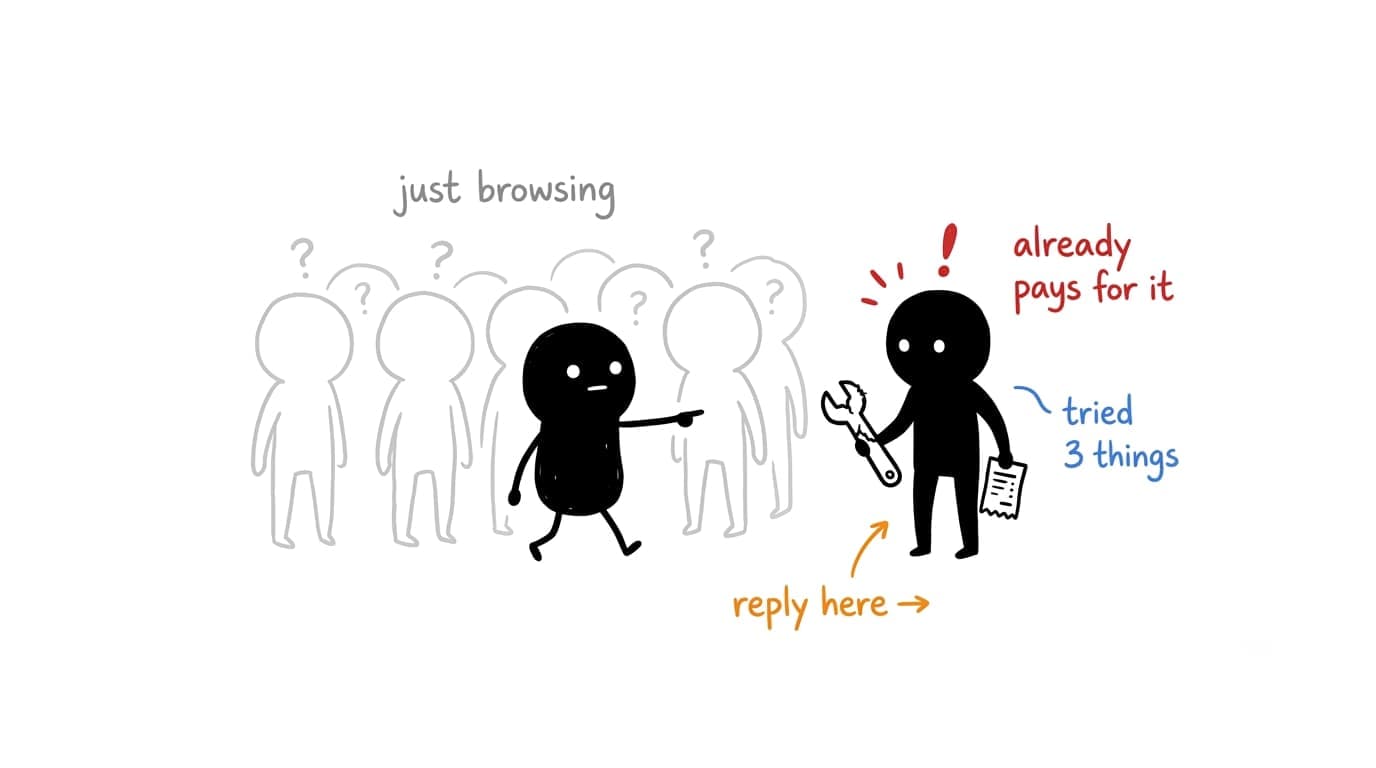
a vague "anyone use x for y" is usually just idle curiosity. the ones that say "ive tried three things and none work id pay for something that actually solves this" those are buyers.
One commenter pushed back on the instinct to grade every single post, and argued for watching one tell instead. u/jayson_OutreachBloom:
trying to score every post by intent is a waste ... If you want one signal, it's people complaining about a tool they already pay for. That's a buyer with budget approved and a reason to switch.
A second person, u/powleads, confirmed the same tell independently, with a number attached:
we track posts complaining about current vendors as high-intent signals — reply rate is 3x higher than cold email. the 'ive tried 3 things' line ... is the dead giveaway.
What does a repeatable way to find customers on Reddit look like?
Use one tight loop: watch the right subreddits, surface the threads where people complain about your problem, and judge who's actually a buyer. That's exactly what u/Avengerfx said he wanted help with — not "send more messages":
I'd be more interested in someone who can help identify where the pain is already showing up, what language those buyers use, and which segment is worth testing first.
Three jobs, and every one of them is the manual grind from earlier — exactly what eats the hours.
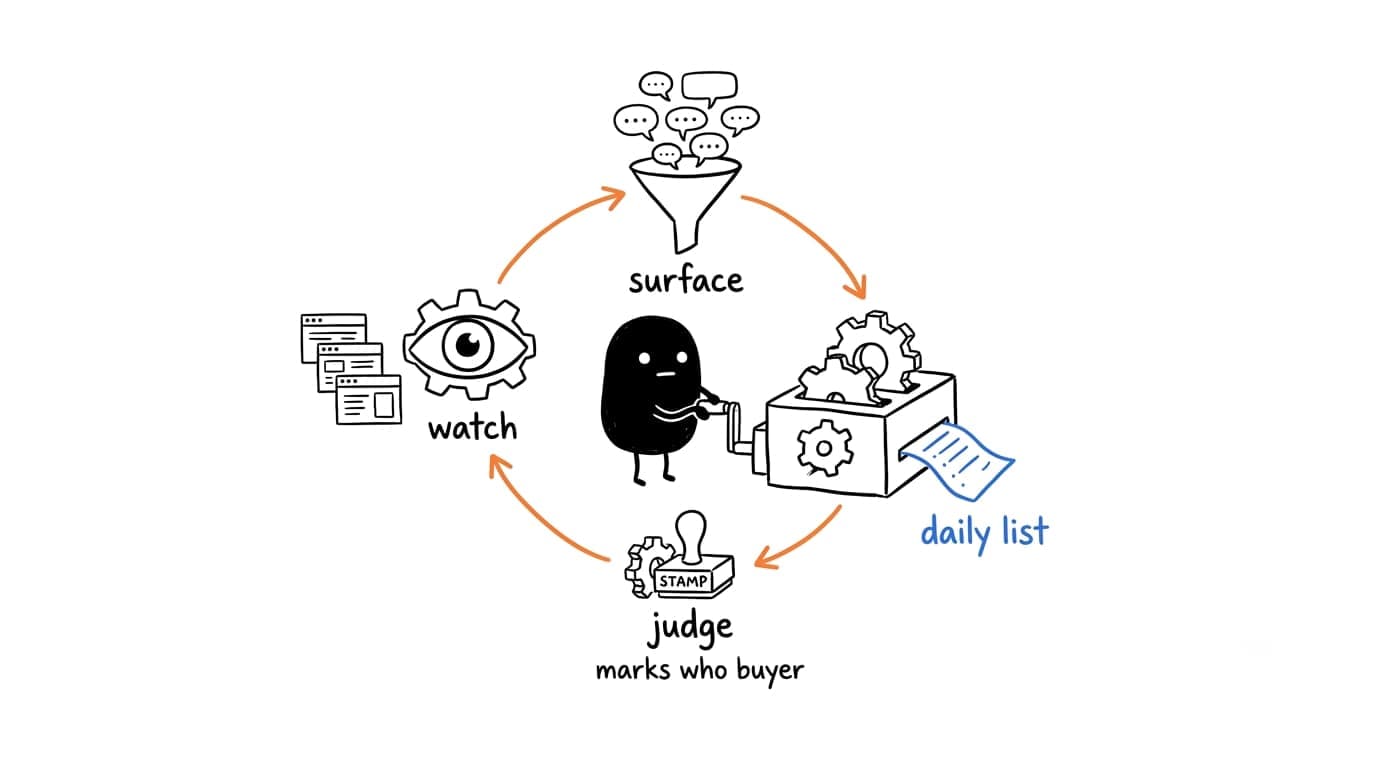
dist0 turns that daily search into a daily Reddit market brief. Paste your site's URL once; dist0 reads what you do, watches the relevant Reddit communities, surfaces candidate pains and leads with the source post attached, and sends the brief to email and Slack. The endless refresh from earlier turns into one short read.
The pattern, in one line
Across 580 posts, the useful advice kept pointing in the same direction, but it was incomplete. The strongest comments said to go where people already complain about your problem. Far fewer mentioned that getting there is a manual grind, and that once you're there, reading who's a real buyer is a separate skill.
That's the step most guides skip: not the strategy, the labor underneath it. The founders who got traction didn't find a better slogan. They did the boring part — watched the threads, waited for the complaint, helped first, and aimed at the one buyer they could actually name.
580 Reddit threads on the wall behind zero users — and the play we'd bet on.
Turn one-off Reddit research into a content loop that compounds.
Frequently asked questions
How do you find customers on Reddit?
Don't broadcast — go to the threads where people already complain about the problem you solve. Watch the subreddits where your buyers discuss the problem (not product communities), reply helpfully in the thread first, and only DM after someone engages with your reply. The advice is simple; the work is watching enough threads to find the right ones.
How can you tell if someone on Reddit is a real buyer or just curious?
The clearest tell from these threads: someone complaining about a tool they already pay for, or listing the three things they've already tried and why each failed. That's a buyer with budget and a reason to switch. A vague "anyone use X for Y?" is usually idle curiosity. One marketer reported that replying to complaint posts gets a 3x higher response rate than cold email.
Is cold DMing on Reddit worth it?
Cold pitch DMs mostly don't work — one founder sent 200 and got a single reply, then got banned for automating them. What worked was the reverse order: add a genuine insight to someone's thread first, and DM only after they engage with your perspective. Lead with help, not a pitch, and stick to one tightly defined buyer.