

On this page
- Every channel rewards a different kind of effort
- Information gain comes from three things — and none of them scale
- How we scale original research without a research team
- What a pattern report actually is
- What the verifiers actually check
- Does this break Google's scaled content abuse policy?
- Does it actually work?
- Who should copy this
Every channel rewards a different kind of effort
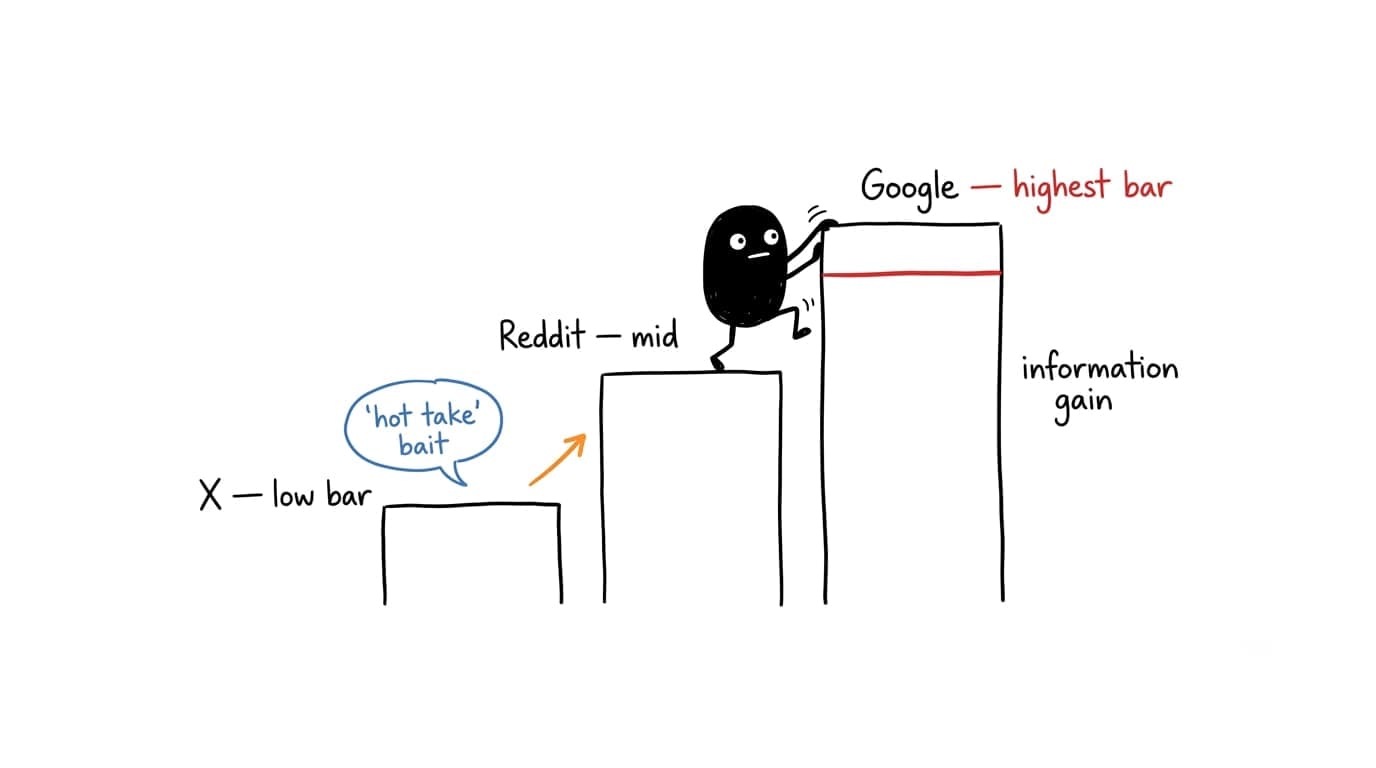
Every marketing channel sets a different bar for how much new information you have to bring. I've come to think of it as three tiers.
On X, the bar is basically zero. People reward a sharp take, a clean distillation, a bait that makes them stop scrolling. You can repackage something everyone already knows, phrase it well, and do fine. Nothing wrong with that — it's just the game on that surface.
Reddit sits in the middle. The community rewards content that fits the room and adds something, even if half of it is common knowledge. A genuinely helpful comment that pulls together what's already out there, plus a bit of your own read, lands well.
Google has the highest bar. And it keeps getting higher.
What Google wants — and what AI search is converging on — is information gain: how much new, original knowledge your page adds on top of everything already indexed for that query. This is Google's own stated bar. Its guidance on helpful content tells you to ask whether a page provides "original information, reporting, research, or analysis" and "substantial value when compared to other pages in search results" — and, if it draws on other sources, whether it goes beyond "simply copying or rewriting" them. Google has even patented the idea by name: Contextual Estimation of Link Information Gain, granted in 2024, scores a document by the additional information it includes beyond what the reader has already seen. The term is Google's; so is the standard.
The reason this matters more now is AI. ChatGPT and Claude have read the internet. They can produce a perfectly average, comprehensive summary of any topic quickly. So that kind of generic, model-reproducible synthesis is worth almost nothing now. The old skyscraper move — study the top-ranking results, write something slightly longer covering the same points — is chasing a version of Google that's already gone.
If your content can be regenerated by a model that read the same sources you did, it has zero information gain. That's the bar now.
Information gain comes from three things — and none of them scale
So how do you actually produce information gain? When you read past the SEO jargon, it almost always comes down to one of three sources:
- Original research — you went and measured something.
- First-hand experience — you did the thing and reported what happened.
- Proprietary data — you have numbers no one else has.
People who study this all land in the same place: the reliable way to be additive is to bring data or experience the rest of the web doesn't have (Backlinko makes the same point). Google says it directly, too — its guide to ranking systems describes a reviews system built to reward "insightful analysis and original research," and original-content systems that surface "original reporting" ahead of pages that merely cite it.
Here's the catch. Look at those three sources again and notice what they have in common: they're all expensive, and none of them scale on their own.
Original research takes time — design it, collect it, analyze it, write it up. First-hand experience is the worst offender: a human can only live through so many things, and that experience doesn't multiply unless you hire a whole marketing team to go live through more of it. Proprietary data is great if you already sit on a pile of it, but most companies don't, and the pile doesn't grow on a content schedule.
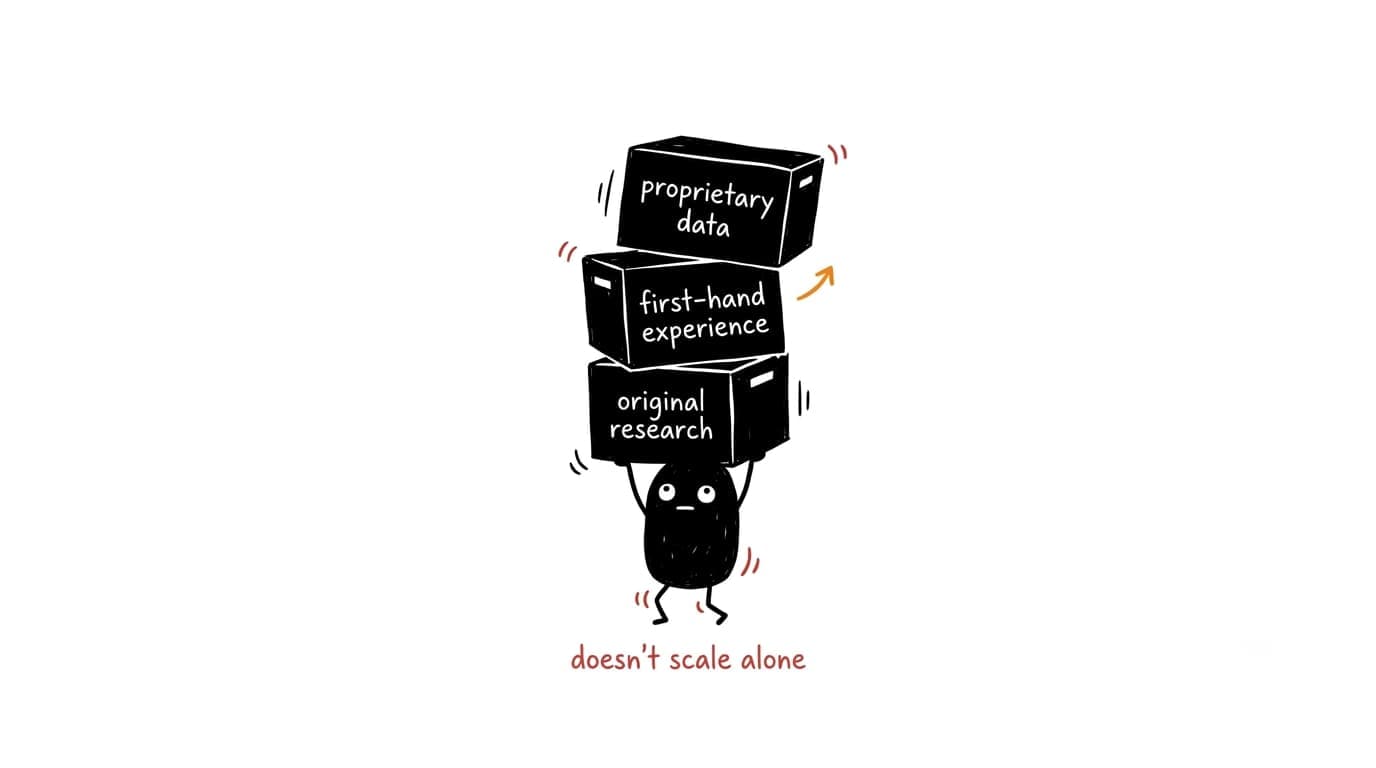
That's the real problem. Everyone tells you to "add information gain." Almost no one tells you how to do it more than a handful of times a year without a research department.
How we scale original research without a research team
Our answer is a format we call the pattern report.
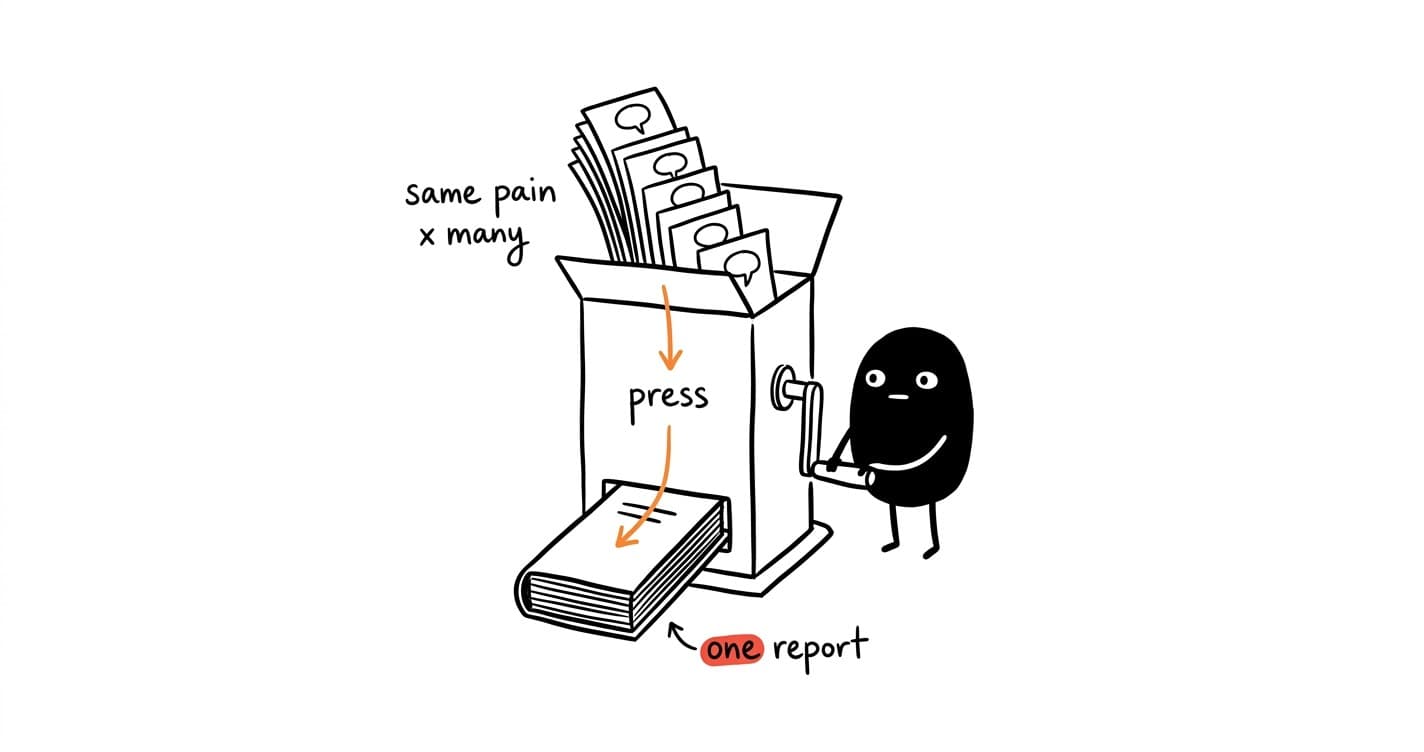
The trick is to stop treating "original research" as something you have to personally live through, and start treating it as something you can collect and synthesize at scale. The raw material is already out there: people describing their problems, in their own words, every day, in public.
We give dist0 our own URL — dist0.com — and it reads the site, learns our product and audience, and picks the Reddit communities to watch. It reads Reddit and surfaces sourced pains; we use those sourced posts as the raw material for the report. Then we synthesize those pains — and the fixes people actually tried — into a single report.
That's original research. Not because we ran a survey, but because nobody else has read those batches of Reddit posts, grouped the recurring pain, and written down what worked. The synthesis doesn't exist anywhere on the web until we publish it.
And the strategy is portable. You don't need to be us. Point the same process at your communities, collect the pains your product resolves, write the pattern, and at the end, introduce your product as one of the fixes. The report earns its keep as a piece of genuinely useful research; your product shows up where it's actually relevant.
What a pattern report actually is
A pattern report is an honest analysis of a shared user pain and the fixes people took to escape it — imperfect fixes included. Two we've published:
- How to find buyers in the noise — the recurring pain of finding real buyers in a crowded feed, and what works.
- How to get your first users with no audience — a near-universal founder pain, and the solutions that hold up in practice.
The voice is documentary. We're not trying to deliver grand thought leadership; we let the community speak for itself and report the pattern faithfully. That's exactly why it scales — when the job is "report what's there" instead of "invent a brilliant thesis," the writing effort drops a lot.
But documentary doesn't mean thin. Every report runs through three steps:
- Collect and analyze. dist0 reads Reddit and surfaces sourced pains; we use those sourced posts as the raw material for patterns instead of relying on a single loud thread. Doing this by hand would take days.
- Re-read for context. An AI agent goes back through the full posts to deep-dive each pain — what people actually meant, what they tried, what worked. This is the step that keeps us from misreading a commenter's voice and putting words in their mouth.
- Write and verify. We draft with AI, then run the draft through a set of focused verifiers — small automated checks that each test one specific way the writing can fail. The agent fixes what they flag and re-checks until nothing's left. We call this loop marketing — we loop for content quality, not for engagement numbers.
What the verifiers actually check
Each verifier has one narrow job — one broad "make this better" review only gives broad, useless advice. Every draft gets checked for:
- Topic worth — is there real information gain, or could anyone regenerate this?
- Coherence — does every section support the title?
- Fact-check — is every number, quote, and link sound?
- Product proof — can we actually back each claim about dist0?
- Brand fit — does it sound like us, not generic marketing?
- Search clarity — can a person and a search engine pull out the answer?
- Writing style — does it read human, with no AI tells?
The loop marketing post walks through each one.
Does this break Google's scaled content abuse policy?
No — because the policy targets intent and value, not authorship or scale, and a pattern report clears it on both. But it's a fair worry, so let me show the work.
In March 2024 Google rolled out a scaled content abuse policy, and it's deliberately method-agnostic. It doesn't matter whether a human or a machine wrote it.
But read what it actually targets:
"Scaled content abuse is when many pages are generated for the primary purpose of manipulating Search rankings and not helping users... creating large amounts of unoriginal content that provides little to no value to users, no matter how it's created."
The test is intent plus value, not authorship, and not scale by itself. Original, high-quality content built to help users doesn't trip the policy, however it's produced. A pattern report clears the bar on every count:
- It's original analysis, not a restatement. The substance is the synthesis — the grouped pains, the fixes people tried, what held up. That synthesis is the page itself, not a few quotes with commentary added on top.
- It's specific to who you serve. dist0 keeps project memory about your product and audience, so the same Reddit posts can point different businesses toward different reports. The output reflects your customer, not the niche.
- It's first-party research on fresh data. Reddit research at this depth is rare, and each report covers a distinct pain — no near-duplicate pages rolling off a line.
- The bar is recurrence, not noise. A pain only becomes a report when it recurs across multiple posts from distinct authors in the batch we analyze. The signal is the same complaint from distinct authors — that's a pattern, not one upvoted thread.
This is scaling original research, not content output. We're aiming to publish one researched report a week to keep the data fresh — not the large-scale, low-value content the policy describes.
Does it actually work?
Not yet — I can't show you ranking data, because I only just started running this. I won't pretend otherwise.
What I can stand behind today is the input. Every report is original, first-party research that doesn't exist anywhere else on the web — precisely the thing the information-gain signal is built to reward. The ranking outcome is what the weekly cadence is designed to earn over time, and I'll report back when there's data worth reporting.
Who should copy this
Founders and small marketing teams who want to publish a steady, genuinely original report — to their community, as an SEO blog, or both — without standing up a research department.
If that's you, the shape is all above: give dist0 your site URL, use the sourced pains it finds, write the pattern, and place your product as one of the fixes. One report a week. Each a distinct pain. Each something only you have written down.
That's the whole move. Not more content — more original research, on a schedule you can actually keep.
Frequently asked questions
What is information gain in SEO?
Information gain is how much new, original knowledge a page adds on top of everything already indexed for a query. The term comes from a Google patent, and the principle is written into Google's own helpful-content guidance, which rewards "original information, reporting, research, or analysis" over pages that restate what already ranks. Pages that merely repackage what's already indexed have low information gain; pages with original research, first-hand experience, or proprietary data have high information gain.
What is a pattern report?
A pattern report is an analysis of a shared user pain and the fixes people actually tried, synthesized from real community discussion. We use dist0 to find sourced Reddit pains, group recurring pain across distinct authors, and report what worked — original research that doesn't exist elsewhere on the web.
Does AI-written content violate Google's scaled content abuse policy?
Not automatically. Google's March 2024 policy is method-agnostic — it targets content made primarily to manipulate rankings with little value to users, whether written by humans or machines. The test is intent plus value, not authorship or scale. Original, useful content is fine however it's produced.
If competitors all collect pains and write pattern reports, don't the outputs converge?
No. dist0 keeps project memory about each business's product and audience, so the same posts can produce different reports depending on who you serve and which pains you can actually solve. The report reflects your customer, not the niche. First-mover advantage is a bonus on top — the earliest strong report on a given pain has the best chance to become the page others reference.